See migration pressure build — early enough to act.
LIMSS turns scattered migration signals into earlier insight — helping organizations understand where pressure is building, why it matters, and where support may be needed next.
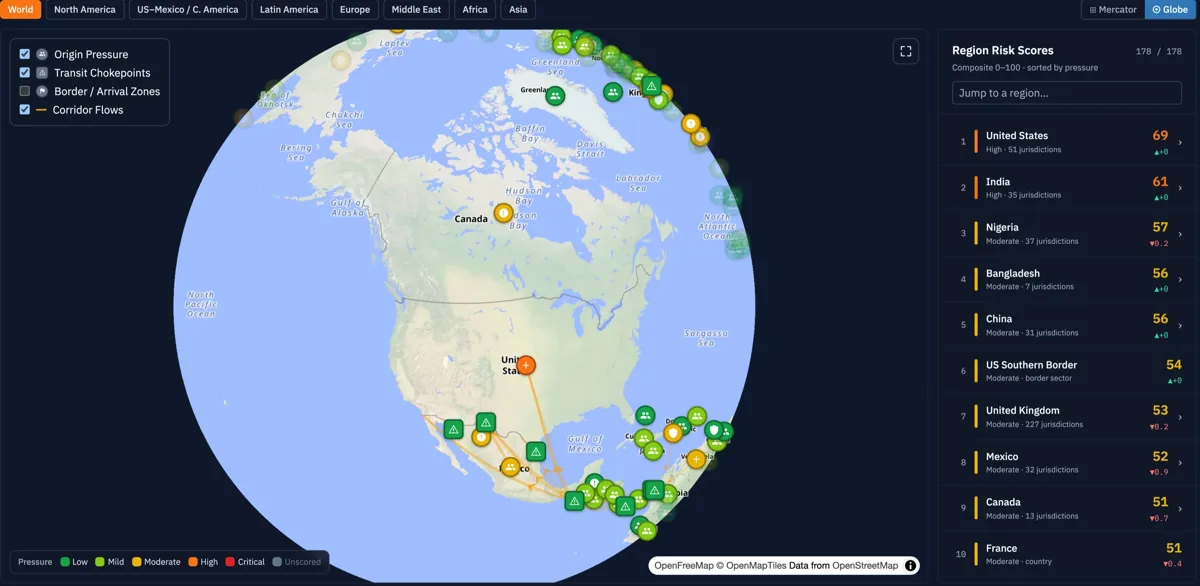
Better information. More time. Earlier action.
Migration is often treated as a crisis that begins at a border. But the pressures that drive displacement build much earlier — conflict disrupting food systems, climate shocks destroying livelihoods, violence forcing families from their communities, weak institutions leaving people without support. Those pressures can compound until remaining becomes more dangerous than leaving.
LIMSS was built to see that earlier. The LEAD IMPACT Migration Sentinel System (LIMSS) is an AI-enabled migration intelligence and foresight platform that brings together near-real-time, open-source information to help identify emerging migration and displacement risks before they become larger humanitarian, social or operational crises.
Our goal isn’t simply to track where people are moving. It’s to understand why pressure is building, where needs may emerge, and what can be done earlier. The purpose isn’t to predict an individual’s behavior — it’s to recognize changing conditions early enough that organizations have more options to help.
To give communities and decision-makers more time to act — by responsibly using AI and trusted information to identify emerging migration pressures earlier, strengthen preparedness, and help move resources and support where they may be needed before conditions become crises.
More time means more choices.
The value of early warning isn’t simply knowing sooner. It’s having more choices about what to do next.
- Conflict
- Climate shocks
- Food insecurity
- Institutional weakness
- Economic pressure
- Detect signals
- Connect patterns
- Assess risk
- Pre-position resources
- Prepare services
- Coordinate partners
- Protect vulnerable communities
- Reduce crisis-driven response
From signals to earlier action.
Conflict, food insecurity, climate shocks, economic instability and weak institutions can build long before large-scale movement becomes visible. LIMSS brings those signals together.
- 1
Detect
Monitors open-source reporting, humanitarian data, conflict and climate indicators, economic conditions and food-security signals as they publish.
- 2
Connect
AI filters noise and connects developments across time and geography, surfacing when multiple pressures may be converging.
- 3
Assess
Translates signals into a traceable 0–100 index, showing what's changing, why, and which factors are driving it.
- 4
Anticipate
Maps and corridor analysis show potential movement pathways and the pressure that may emerge in transit and destination communities.
- 5
Support
Alerts, source-linked intelligence, Ask LIMSS, executive summaries and downloadable reports — built for earlier decisions.
LIMSS focuses on patterns, not people — these are evidence-based foresight assessments, not claims of certainty.
Source trust is weighted
Official data outweighs open news, by published weights.
Every score has lineage
Open a region, read the events and links behind it.
Honest about coverage
Only regions with active collection are counted.
Each factor scores 0–10 from validated events, weighted by source trust, then rolls up into one banded index with an evidence-coverage reading.
Everything you need, in one platform.
Risk Overview
Live map of monitored regions, scored and banded.
Real-Time Monitor
The classified event feed behind every score, updated continuously.
Intelligence Analysis
Factor-by-factor breakdown of why a region scores the way it does.
SIRS
A second score for the receiving side — strain on housing, services and capacity.
Ask LIMSS
Ask in plain language, get a sourced brief back.
Executive Intelligence Summary
A one-page readout for decision-makers, exportable as PDF.
Technology with a human purpose.
Humanitarian & nonprofit organizations
Identify where needs may surge and where food, shelter, medical support, protection or field assessment may need to move sooner.
Governments & planners
Improve preparedness for housing, public services, infrastructure, border or processing capacity, and cross-border coordination.
Researchers & educators
Explore real-world migration drivers — conflict, climate, governance, economics — and how they intersect with human mobility.
International organizations & partners
Add near-real-time situational awareness and source-linked analysis to existing planning and field information.
Privacy-conscious by design.
LIMSS focuses on patterns, not people. The platform is designed to analyze aggregate trends, regional conditions, migration drivers and publicly available information — not to identify, follow or profile individual migrants. Human judgment stays central, and source transparency supports responsible interpretation.
Aggregate only
Patterns and regional conditions, never individual migrants.
No surveillance construct
Nothing here identifies, follows or profiles a person.
Source-transparent
Every score traces back to the published items behind it.
Human judgment central
LIMSS informs a decision; it doesn't make one.
Four steps to working in it.
- STEP 1
Tell us your need
Who you'd be serving, and we'll advise on the fit.
- STEP 2
Request access
Who you are, and the regions you care about.
- STEP 3
We provision
Your organization, seats and corridors switched on.
- STEP 4
Sign in
An invitation arrives; the full platform is there.
Asked first.
Where does the data come from?
Openly published sources only — UN agencies, national statistics, humanitarian reporting, climate data, policy research and open news. Every event keeps a link back to the original item, and the source categories and their trust weighting are set out in the platform's methodology pages. The specific provider list is proprietary and shared with customers under agreement.
Does LIMSS track individuals?
No. It works at region level on published reporting, holds no personal data about migrants, and carries no crime, threat or enforcement constructs by design.
What counts as a monitored region?
One with active collection configured against it. Regions are switched on as customers need them — part of onboarding, not a code change — and we only ever count what is actually being collected.
How current is it?
The global firehose runs every fifteen minutes; official statistics and climate feeds run on their own cadences. The figures at the top of this page are read live from the platform.
Point it at a corridor you already know.
The fastest way to judge LIMSS is to check its reasoning against a situation you can already describe.